
A deck in Steamboat Springs or Vail isn't just a deck. It's under 8 months of UV assault, buried in snow for a quarter of the year, and expanding and contracting with temperature swings that can hit 60°F in a single day. Material choice on a mountain deck determines whether your client is calling you for refinishing in year 4 or bragging about it in year 12.
Here's what the options actually look like in Colorado's mountain climate.
Most decking manufacturers test their products in mild coastal or mid-Atlantic climates. The combination of conditions at Colorado altitude is close to worst-case for exterior wood and composite alike:
Natural wood is still the preferred aesthetic in most luxury mountain markets. Clients in Vail and Snowmass want the warmth and character that no composite reliably replicates. The challenge is protecting it well enough that it stays that way.
Cedar is the most common natural decking choice in the Mountain West for good reason: it's naturally rot-resistant, dimensionally stable relative to other softwoods, and takes stain beautifully. Vertical grain cedar is significantly more stable than flat grain and is worth specifying on any project where finish longevity matters.
Unfinished cedar will silver and check. Finished cedar, properly coated on six sides including end grain, will hold for years at altitude. The difference between a cedar deck that looks great at year 8 and one that doesn't is almost entirely the quality of the initial finish and whether end grain was sealed.
Knotty cedar is a cost-effective alternative for budget conscious buyers.
VG Doug Fir decking is dense, strong, and holds a finish well. It's used frequently in mountain residential construction because it's locally sourced and cost-effective relative to exotic hardwoods. For decking applications, specify vertical grain. Flat-sawn fir will check aggressively in Colorado's humidity cycles.
Exotic and domestic hardwoods are increasingly common on high-end mountain builds. White oak in particular has become a go-to for designers who want a domestic species with a strong visual identity. These materials are denser, harder, and more dimensionally stable than softwoods, but they require proper pre-drilling, appropriate fastener spacing for expansion, and high-quality penetrating finishes rather than film-building coatings.
Other common hardwoods include Teak, Mahogany, Tigerwood and Garapa.
Thermal modification is a heat treatment process: wood is kiln-heated to 400°F+ in a low-oxygen environment, breaking down the sugars and starches that fungi and bacteria feed on. The result is a material that's dramatically more rot-resistant, more dimensionally stable, and darker in color, without any chemical treatment.
For mountain decking, thermally modified wood hits a sweet spot: it looks and installs like natural wood, it can be Class A fire rated with appropriate treatment, and it's significantly more stable than untreated wood in high-humidity-swing climates. Maintenance is lower than standard cedar or fir.
The trade-off is cost. Thermally modified decking runs higher than knotty cedar. For clients prioritizing low maintenance and natural aesthetics, it's a compelling spec.
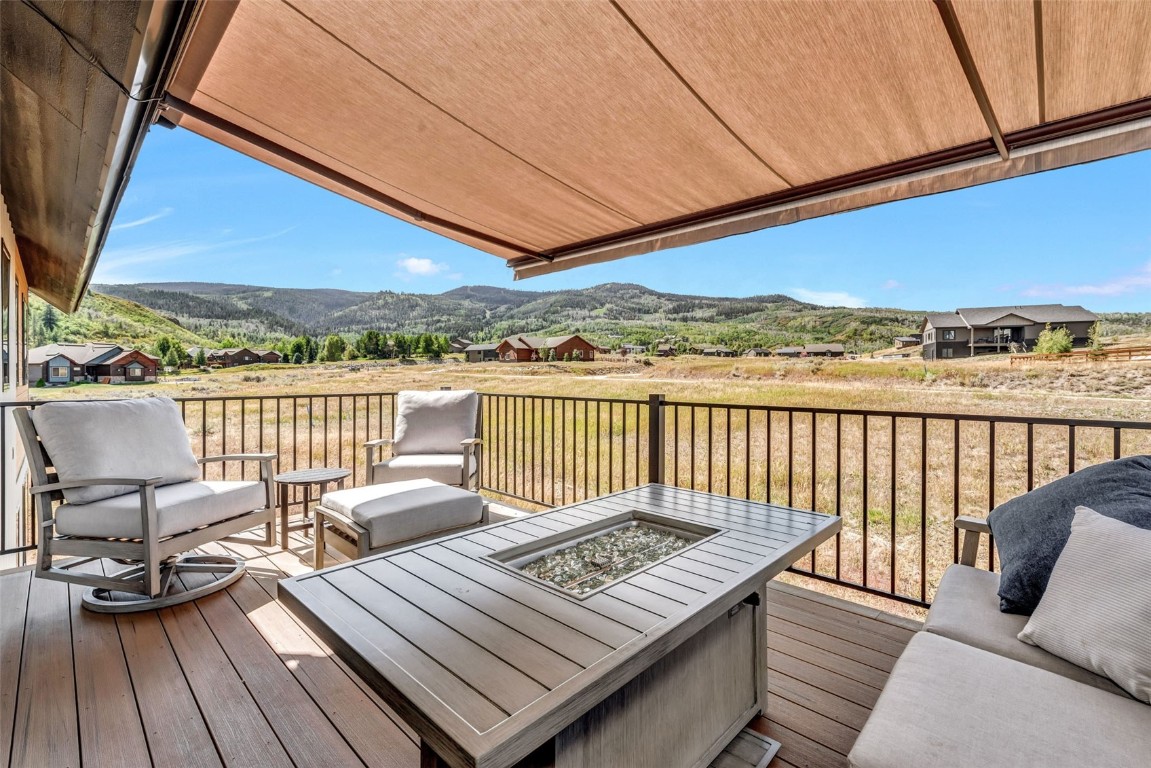
A mountain deck done right – Colorado open space views, composite decking, covered outdoor living.
Composite is the low-maintenance pitch, and it's a legitimate option for clients who don't want to think about refinishing every few years. But altitude creates real limitations that the marketing doesn't emphasize.
The single biggest predictor of how long a natural wood deck looks good in Colorado is the quality of the initial finish, and whether all six sides were coated before installation. Once decking is fastened down, the underside is inaccessible. Field finishing the face after installation leaves the bottom face, edges, and end grain exposed to moisture wicking from below.
Rocky Mountain Finishes prefinishes decking boards before they ship (face, back, edges, and ends) in factory-controlled conditions with coatings spec'd for high-altitude UV exposure. By the time boards reach the jobsite, they're protected on all sides. Your crew fastens finished material, touches up nail and screw points with the included touch-up coatings, and moves on.
| Project Type | Recommended Material | Why |
|---|---|---|
| Luxury custom home, natural look | VG Western Red Cedar or Thermally Modified | Best aesthetic, holds finish longest when prefinished |
| High-end home, low maintenance priority | Thermally Modified Wood | Natural look + rot resistance + lower refinish frequency |
| Production or spec home, budget-conscious | VG Doug Fir, prefinished | Strong finish, cost-effective, locally relevant species |
| Client wants zero maintenance | Capped PVC Composite (light color) | Best UV resistance among composites; avoid dark colors |
| WUI-zone project, fire code priority | FRTW Decking or Non-Combustible | Check county-specific WUI requirements before specifying wood |
In Colorado Wildfire Resiliency Code (WRC) designated WUI zones, which cover significant portions of Routt, Eagle, Pitkin, and Grand counties, decking material may be subject to fire-resistance requirements. Standard cedar and fir do not meet Class A fire ratings without fire-retardant treatment (FRTW). Confirm the WUI designation and any HOA overlay requirements before locking in your decking spec. We can supply FRTW-treated natural wood where required.
We supply and prefinish natural wood decking (cedar, Douglas fir, white oak, thermally modified species, and more), all finished at our Craig, CO facility with coatings spec'd for high-altitude performance. 2,000+ stain and solid color options.
FOB Craig, CO · 4–6 week lead time from deposit · 2,000+ colors · 30-year coating warranty available
Ready to talk about your next project? Reach out to Luke Tyler at ltyler@rockymountainfinishes.com.